Wednesday, 8 March 2017

Women's Day


India is a land, where all women are looked up to the highest possible respectable position, "Mother". Even the 3 supreme gods, Shiva, Vishnu & Brahma were made to bow before "Adi Shakti", the divine mother. Supreme Shiva is depicted to beg before his wife Annapoorna, to show that, women are indeed superior. The nation is recognised and loved as "Mother Land" ( clearly disproves, society is patriarchial). The respect comes because, women make sacrifices to bring up future generation of valuable citizens. Without this "sacrificial" action, the respect given to women will not survive.

Historically a dancing statue was recovered from Harappa. Precious gems adorn the figurine. It clearly depicts, men were offering the "precious" objects to women right from this prehistoric age to show their respect. The respect & love for women exists from pre-historic times in india. Men never demanded equality of burden, when a war was thrust on the nation. Men excluded women of hard work out of respect. In vedas, many compositions are attributed to women. Ramayana, Mahabharatha wars were fought for the respect of women. Many men died in the war for the respect of Sita or Draupadi, although they were in no way connected to women in question. Rama was not a king. Vanaras fought on his side to bring back Sita. How justice is served to massacre 1000s for the sake of 1 woman? and why would one risk his life & fight for a wanderer like Rama against a mighty king like Ravana? It happened because all Vanaras  considered sita as their mother. If it was just another "woman" not even a dog would have fought for sita. When it is "mother' or mother land, infinite value get asoociated. Not just 1000's, masacre of million of life also get justified for the cause. Akkamahadevi composed vachanas among male dominated Sabha. She was well received and respected not just in the men's club of social reformers, but also in society. She was offered the role of akka, the elderly sister to societal population. In the absence of king, many women ruled kingdom as "Raja Mata" and not as "Queen". Ruling "Queen" is a western concept. The relation in queen role was royalty vs subjugates. Indian "Raja mata" position offer mother - Children relationship. Women were never excluded from any of the positions or roles. If there were exclusion, it was only for their protection or to save them from hardship.

Unlike India, in west, women were treated as objects of pleasure. Women were subjugated to slavery. Women were barred from many roles (due to gender bias). Women were discriminated and looked down. West respected muscle power always. Hence women were treated as weak and second class citizen. The suppression existed till 18th century. After industrialization, as cheap workers were required suddenly in large numbers, industrialists started to look at women as a source for employment. This necessitated education in women. Schools were opened for women in west only in 18th century. However look at India. In 8th century, at kaashi, shankaracharya selected opponents wife as the judge. Kaashi was the seat of intellectuals. There was no paucity of learned men to act as a judge. Any debate between scholors at kaashi was something of paramount important to society at that time. If woman was not educated, how one could judge a debate between 2 big titans on a complex set of subjects? So, it proves women were educated in medivial India. Customs & practices changed due to muslim invasions. The discussion at kaashi between shankaracharya & mandana mishra was an open challenge. It went on for several days, spanning a wide range of subjects. A woman was selected as judge. At that time a learned woman was known to hold justice with impartiality, as she adorns the seat of mother. The elevated position of motherhood was giving the lady to look at both participants as her children and hence there was no scope for partiality. That's what happened. Shankara with superior intellect was judged winner, although the lady lost her husband, pride & riches from her life due to her judgement. But her act unified India under Shankaracharya that resonates even today. That is the kind of sacrifice a woman can do, hence she was respected with highest possible position in India. When none of the powerful learned men at kaashi stoped a woman from occupying a judgemental seat to script an important event in history in medivial India, why would anyone stop the progress of an Indian woman in modern India, if she is talented and capable to achieve in her chosen field? If opportunity is naturally given, why fight for it?

When we have such an example from medivial India, that is uncomparable in world,  do we really need a women's day? India had a woman PM & president. US has not offered this role to a woman even after 3 centuries of Democratic rule. Should US companies preach Indians or should it be the other way? Indira Gandhi tried to snatch power with emergency (like women are instigated to snatch positions by leftists). She was defeated misearably. The same Indira came back with a promise of playing a "motherly" role. She was not just pardoned, but re-elected with resounding victory. Kumari Jayalalitha was not even married. When she adorned the hat of "Amma", entire state simply surrendered at her feet. No question asked. Absolute power & respect was given. No where in the world a second example can be given. That is how "position of mother" connects to Indian hearts.

When Indian customs and tradition calls for respecting women on a daily basis as a motherly God, what is the need to celebrate a materialistic womens day on only one day of the year with a notional respect? Women's day is hijacked by left ideologists. Today, the leftists are calling for fight between genders for womens rights. They are advocating to garner positiion like a reservation policy. It is not out of merit, talent or because of respect. They are infact advocating women not to make sacrifices. Children enjoy benefits because parents pay for it. If women are instigated to avoid sacrifices, it will reflect on children. If children are affected, the future of the country is at stake. Look at America. Why majority of kids are obsess? They are obess because their "super moms" do not have time, but feed junk food. Who is affected because, mom is busy? It is the kids and future of USA. USA is fast loosing its clout from No.1 position.

The "fight" between genders will create tensions and pressure in society. It increases societal burden. Leftists are instigating women to snatch benefits in the name of "rights" without paying a price (or taking liability). There is no free lunch in this world. This snatching of benefits without paying for it, amounts to theft and skews the burden in family. It will basically create hatred between genders.  For the sake of women votes, & to sell some beuty products citizens are taken for a ride in the name of women's day. Western women's day is preaching Indian women to lower their standard from the seat of "mother" to "just another woman". Woman who fall for this trap will be summarily rejected by the society. That is the "hard" fact.

Indian culture doesnot connect with this kind of materialistic women's day. In Indian context, if it is celebrated as Mother's day, it will be more meaningful. An event that doesnot connect to peoples heart will not lost long. Indian festivals & customs that connects to their hearts were carried forward from ages, inspite of many onslaughts by invaders. If the spirit of women's day is celebrated as mothers day, it will have a chance of survival in this country.

Afterall do we really need to blindly ape the west and lower our standard? When entire tamilnadu state bowed and bundled absolute "power" at the feet of Jayalalitha, is there a merit in the leftist argument, women rights are under threat in this country?

Monday, 6 March 2017

India as king maker for global politics

Primarily, there are two political forces driving events around the world. One is called "Right". The group was driven historically by Imperialists, Nationalists and the 'Church'. The group enriched Industrialists and believed in accumulation of wealth and hence controling power. As Imperialism, Nationalism, Religion & Industrialist have joined hands, a new name was given. the partnership is now popularly called "Democracy". While left is popularly known as "dictatorship". Both forces will install a govt and easily lobby for their benefits.

The "right" was challenged by "Left' ideology started in Europe primarily in France and Germany. The Left became a major force due to Karl Marx. The WW2 was a clash between Imperial (Right wing) England and Leftist Germany (Left wing). The conflict spread around the world. After the German defeat in WW2, Left became prominent in Russia & China, while all imperialists consolidated under NATO (US).  After WW2 win, Imperialists gained second victory with the collapse of USSR. But this power dominance is now being questioned with the emergence of prosperous China (left). The 'Rights' are under stress due to their mistakes in economy. The clash is surfacing in Europe and fresh round of conflict is brewing. The conflict may erupt in to a war. The situation is being precipitated by actions of US.

Both left and right tried to influence all countries and tried to rope in support. As far as India is considered, surprisingly 'right' who was in power started playing a  'leftist" drama. As public sentiment was against imperial England, to avoid India tilting its power towards left,  a 'center left' was created. Policies were shown as left oriented, but benefits were funneled to 'rightist' classes. This duality game was the reason for corruption. We see hypocracy every wher, and things arr alwats not straight forward. The name adopted for this drama was "center right" popularly known as congress. This was the reason for daily "political Tamasha" in India and India being reffered to as Banana republic.

In the process of suppression, Indian imperials and true leftists were both crushed. Businessmen/Dalaals managed the show on the back.


Both left and right has to fight and find a balance, else society will not be peaceful. I think the graph depicting benefits to public vs political force is a bell curve. When left and right is balanced at center, maximum benefits is delivered to public (like in Europe). Dominant right or dominant left will always be sub-optimal. Unfortunately, India is Dominant Right force although British relinquished power. That is why, Indian black money accumulated in west. This will continue till left finds their place as meaningful opposition.

I think Indians are now fed up by the daily, duality and drama. The real right is gaining momentum. The shift is actually from centre-right to extreme right.This is the reason for debacle of Congress (center right) and emergence of BJP on national picture. Indians now realised "real" right is better than "disguised" right. Atleast you know who are they and what they stand for. The elimination of duality and strengthening of right may eliminate corruption, but it will not stop looting of people. The money will be taken directly instead of disguised forms. Unlike what Indians think, nothing much will change on the ground due to NDA coming to power. Policies will be clear as they will now be clearly aligned to right ideology, but it will surely bring more "viloent" fights between Right & Left on the street. Due to emergence of right, left will also start to strengthen (Newtons 3rd law applies). Both "Right' and 'left' will start influencing citizens in their true colour, instead of dummy center right.

This is setting the stage for re-writing various fundamental aspects of Indian society. Media calls it as safronisation, while Right calls it as correcting historical blunder. Have a look at the talk in the link. The "Rightists" honestly accept the situation. It is very interesting.

What is more interesting is, what will India do in the brewing conflict in Europe? Will it support "Right" forces lead by America and risk its border with China or join true left and put its weight behind its all time ally Russia? India is being setup against China with offers of UN permanent membership, while Left is attracting India with BRICS mantra & more influencing role. You see this fault line in Kashmir. To keep India in.check, Left forces will keep the Kashmir burning. The intensity may rise as hidden right has come open now.

What India does will tilt the balance of power and decide the next battle in Europe. India is important today for this reason. If India makes its stand clear (coming out of its non-aligned posture), The battle in Europe may get decided, even before it starts. India is now in the "King maker" position.

Sunday, 22 January 2017

Harappan unicorn symbol and issue of horse to prove Indus valley and vedic civilizations are one and the same

Image result for unicorn figurine indus

Unicorn and missing horse in Harappan Seals

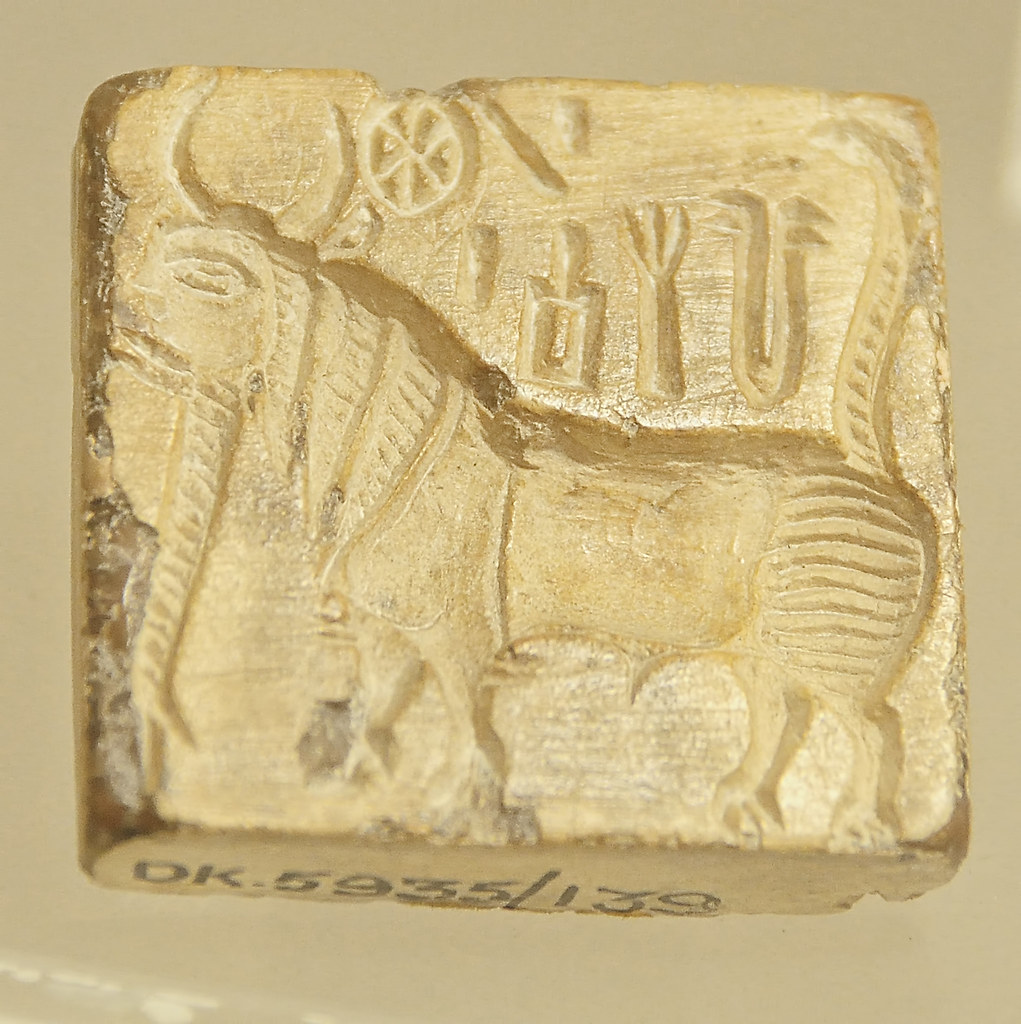
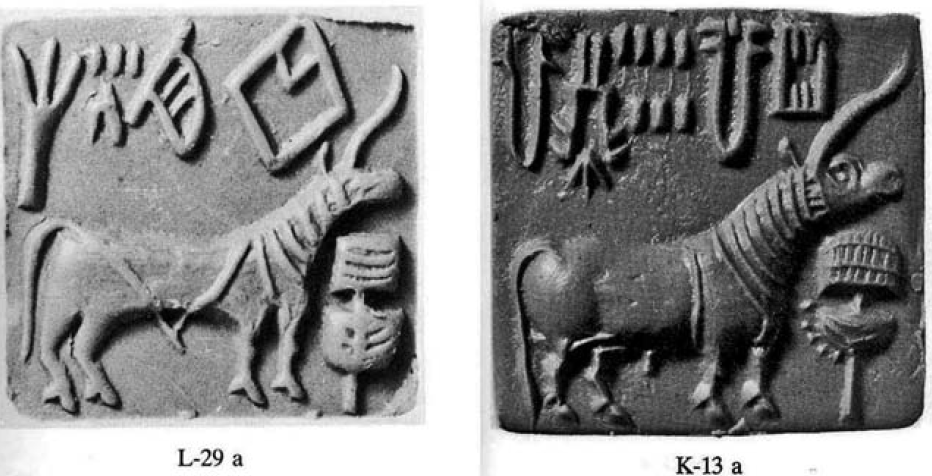
Unicorn seal is the first seal found in harappan excavation. It is widely collected from different Indus valley sites. Western scholars think, this unicorn is a mythological animal as no biological remains (like bones) were ever found for a single horn animal resembling the description of unicorn in the world.

There is an interesting question. Why everyone thinks the "horn" as a "real horn"? Why not evaluate alternate paths? As this unicorn is depicted in a ceremonial setting, the horn could be a decoration to the animal (as other decorations observed on its neck and back can be observed) also.

May be a horse without horn looked odd to Harpans, so they might have decided to decorate the missing piece from gods creation. No proof (like bones) of any unicorn is ever found on earth. It is highly possible that, the ceremonial "horn" may have given rise to a story on "unicorn" in olden time itself. The "rushyashrunga" of ramayan itself might have based on such an idea. Without the horn the animal resembles a horse (due to pattern on neck).


Image result for harappan proto shiva

Harappan elephant also seen with decorations (observe pattersn around neck). As seals were used for trading, it was something like a 'trade license'. The sybol on trade license could mean royal emblems or royal animals. Royal animals always comes with royal decorations. So Be it Elephant, Tiger, Bull, Horse, Rhino or Antelope, they are 'Royal" animals belonging to to Head of state. So, the corn on the horse is nothing but a decoration on horse and does not depict a mythological animal 'unicorn' as flouted by western indologist. Every royal kindoms in India had royal animals. They were paraded in royal procession (one can see the tradition of Dasara festival in Mysore kings even today).


Harapan Rhino was decorated. Note the patterns on its neck and back. It indicates some kind of robing the animal for decoration.
 Image result for harappan rhino


Image result for harappan cat

The Bowl below Rhino indicates it to be a domesticated animal, just like the bowl before  bull (shown below). This indicates The Rhino in harappan seal is royal animal and not just some wild animal.


Image result for harappan cat


Same is the case with Tiger. A feeding bowl indicates, it is not wild tiger and hence it must be a royal animal.


Image result for harappan cat

Image result for harappan rhino


Image result for harappan rhino

Strange decorations to an animal. It is understood as all royal animals super imposed on to the body of unicorn (which is nothing but horse).

Image result for harappan rhino


Related image


Horse is useful animals to traders to move their goods from place to place apart from bullock cart. It is also surprising to note, the harappan seals normally do not depict dog, goat, sheep or hen (the usual domesticated animals). There is another important underlying factor that historians overlook intentionally. The seals are understood generally as identification plates while trading goods. But historians are treating these seals as a 'book of history'. They are expecting recording of every aspect of Harappan life in seals. In simple terms, it is like, looking for material on nuclear fusion in a commerce book. Why should all aspects be depicted in trade symbols? presence of some aspect (for example bull) emphasizes that Harappan people possibly used bulls for ferrying their goods. What one should conclude is that, presence of some aspect may emphasize a historical fact, But absence of some aspect may not necessarily mean anything or prove anything. For example, during bronze age, weapons are a major invention. They gave the real edge over beasts and helped to raise kingdoms. Metal weapon was a priced piece. They should have been the central piece of any art at that time, as it was causing sensationalism or raising imagination with ordinary people (who doesn't have them). But weapons are absent in the seals. Does that means Harappans did not have weapons? No one argues like that. In-fact, Copper/bronze Weapons were indeed found.
Image result for harappan d weapons

Harappan Weapons, National museum, New Delhi

Without weapons, providing protection against wild animals and to provide policing duties is nearly impossible. Without policing duties, it is impossible to build such large scale cities (otherwise, conflicts among citizens would have lead to crimes). So, it is foolish to argue Harappans did not use weapons, just because they are absent in seals. Some tablets in fact contain Indus weapons


Image result for harappan fighting scene
 Harappan using spear to slay an animal (possibly buffalo sacrifice)

Similarly No seal with soldiers or cart or toys or grannery or big bath etc were found. But they do exist (and are considered central to Harapan civilization). In most probable scenario, trading community is barred from using symbols of military or religion [Area belonging to priest (Brahmins) and kshatriayas (warriors)]. Probably stratification of society in to 4 varnas already exist during harappan time (as a template for division of Labor). If weapons are used, it will terrorize a trade rather than establish trust. Hence, in most likely scenario, military, religion etc were avoided in seal making (the items that can raise strong emotions). That could explain the reason for absence of weapons, soldier, gods (like mother god worship ),chariot or horse. The seals may symbolize a region or a town or a business family. It is natural to use animals for symbols (like in zodiac). Note that, Horse or dog is absent in zodiac symbols also. Bull (agriculture), lion(royalty), fish(fishermen) are the prominent animals all along history. Horse and Dog got prominence only after western domination.

Popular Harappan seals depict important big animals (like Bull, elephant, Rhino, Tiger & Antelope).

Related image


Although dog as a toy is found, it is not depicted on seals popularly. Dog, cat, pig, donkey, Monkey etc are considered as lower animals in  Indian culture even today.

Related image
Harappan Fish

Image result for harappan dog
Harappan Dog

Figurine of spotted dog Pakistan, Indus Valley, Chanhu-Daro, about 2600
Image result for harappan dog toy

Harappan Monkey
 Related image

Image result for figurines of indus valley

Harappan Ram

Image result for harappan dog
Harappan Pigs - Found at Rakhigari


Image result for harappan dog

Harappan Hen


Harappan workshops unearthed in NW India


Harappan workshops unearthed in NW India
 
A seal-cum-pendant, made out of steatite, found in the "key trench" at 4MSR. One one side are  engravings of figures of a dog, a mongoose and, perhaps, a goat. On the other are the figures  of a frog and a deer. The pendant belongs to the Early Harappan period (3000-2600 BCE).  The pendant, with a knob-like projection at the top, had a hole too for a cord to pass  through so that it could be worn around the neck [Source: Frontline [July 08, 2016]


So in most probability the unicorn is nothing but the ceremonial horse. Horse is not native to south Asian region. It might have been introduced by traders. But it is bread here for obvious reasons.
Related image

Decorated cow with a bowl. Just because a bowl is shown on the head of cow, it is not a mythical animal.

Related image

Decorated Bull with the bowl on its head. The bowl could mean, the animal is the bread basket for the society.

Western Indologist strategically oppose this. They try to depict unicorn as mythology. Apart from unicorn there is no other mythology detected. Very less is known about Harappan religion or belief.  Harappans seems to be very straight forward. The art is related to their surroundings like animals and flowers. There was no need for that civilization to invent mythology. So, it is wrong to depict unicorn as mythology. In Greek and Roman texts, unicorn is depicted as horse with a single horn. Note that it is depicted as horse and not a donkey with a single horn.


Image result for oldent unicorn painting

Western unicorn. Again, It is depicted as horse with a horn and not a donkey. 

So Greeks might have borrowed Harappan unicorn for their mythology. But Harappan unicorn clearly refers to a horse.


Related image
Harappan man with horse body (like a centaur or a man riding the horse)?

Image result for centaur paintings greek

Centaur of Greek paintings (Check the striking resemblance to Harappan Horse man.


Image result for harappan riders


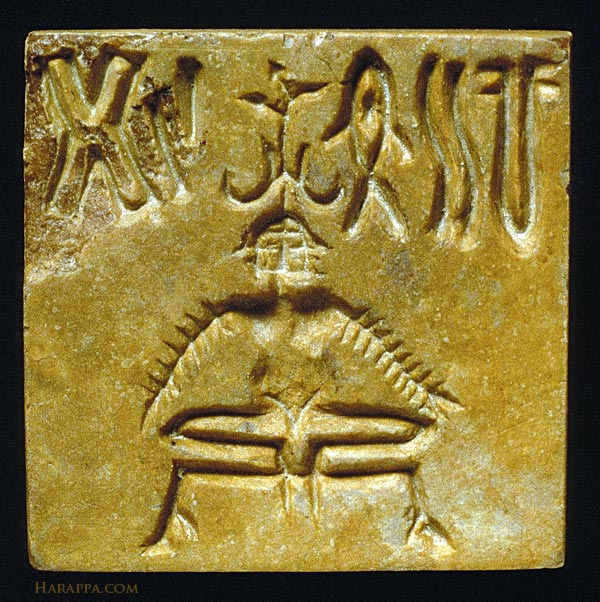
If we closely look at this Harappan seal, one can identify full human body standing in front of horse. Basically it is a superimposition of a man on horse. It actually depicts a horse rider. The elaborate head dress could mean, he is a leader or a king. The waving cloth from the head could also mean, it is a riding scene, as due to wind, the robe could be waving in the air. The overall radiating lines could also mean, the person is very important. The one with "energy", or "Power" or :"God like figure". Even today a "radiating sun" is shown on the back of the god or god-men, to show the enlightenment they bring.

Image result for hindu god with radiating sun on the back of their head

Image result for hindu gods with radiating sun on the back of their head
God, Radiating Energy

Image result for enlightened buddha
Enlightened Budha

Image result for enlightened buddha
Budha radiating energy.


Image result for harappan proto shiva  

The Same can be said about this yogic person. He may be 'Vajra Bahu", meaning person with enormous strength in hands.


Image result for harappan proto shiva

The head dress and the waving scarf can be seen for this king also.  Again look at the strength on his hands indicated by radiating energy.


Related image


Cave paintings older than Harappans depicting horse mounted men (Maharastra India).

Image result for harappan bowand arrow


Another cave painting depicting horse mounted men (Bhimbedka, Madhya pradesh).


Image result for chitradurga horse carving on rock

Cave paintings at anegundi, Karantaka - Horse back riders.


Image result for indus civilisation chariot

Harappan Horse (Note, it is without its horn) - New Delhi, National museum.

Image result for horse figure indus

Many harappan horses (disproving the scantly available horse propaganda).

This is a very important aspect, as missing horse is the last argument western historians are using to oppose merger of Harappan and Vedic civilisations. Although the Aryan migration theory is now busted, the Westerners are playing the horse myth to deny the pride that the harappan civilization deserves. If Harappan and Vedic are proven to be same, it implies Harappan were the sophisticated people in the world. It also implies the Indian race may be superior in traits (due to the kind of planned city of Harrappa and the complex literary work of Vedas. The deep intellectualism exhibited in these items is simply out of their time. This Hurts the egoistic minds of western pride (which is actually racism). So skillfully they bring the argument that unicorn is mythology.


Quote
http://archaeologyonline.net/artifacts/harappan-horse

A historical theory must account for all the evidence and not selectively accept and ignore data. Further, a man-made theory cannot substitute for primary data.

This is not the full story. Sir John Marshall, Director General of the Archaeological Survey when Harappa and Mohenjo-Daro were being excavated, recorded the presence of what he called the 'Mohenjo-daro horse'. Giving salient measurements, comparing it to other known specimens, he wrote: "It will be seen that there is a considerable degree of similarity between these various examples, and it is probable the Anau horse, the Mohenjo-daro horse, and the example of Equus caballus of the Zoological Survey of India, are all of the type of the 'Indian country bred', a small breed of horse, the Anau horse being slightly smaller than the others." ( Mohenjo-Daro and the Indus Civilization, volume II, page 654.) It is important to recognize that this is much stronger evidence than mere artifacts, which are artists' reproductions and not anatomical specimens that can be subjected to scientific examination.

Actually, the Harappans not only knew the horse, the whole issue of the 'Harappan horse' is irrelevant. In order to prove that the Vedas are of foreign origin, (and the horse came from Central Asia) one must produce positive evidence: it should be possible to show that the horse described in the Rigveda was brought from Central Asia. This is contradicted by the Rigveda itself. In verse I.162.18, the Rigveda describes the horse as having 34 ribs (17 pairs), while the Central Asian horse has 18 pairs (36) of ribs. We find a similar description in the Yajurveda also.

This means that the horse described in the Vedas is the native Indian breed (with 34 ribs) and not the Central Asian variety. Fossil remains of Equus Sivalensis (the 'Siwalik horse') show that the 34-ribbed horse has been known in India going back tens of thousands of years. This makes the whole argument based on "No horse at Harappa" irrelevant. The Vedic horse is a native Indian breed and not the Central Asian horse. As a result, far from supporting any Aryan invasion, the horse evidence furnishes one of its strongest refutations.


Another important aspect of Harappan is missing written literature apart from the scripts in seals. The seals were skillfully carved on soap stone. This is artistic work. As traders needed production of repeated printing, they might have payed the price to prepare the seals. Seals were costly and were a symbol of richness. It was worn like a necklace around the neck. So how did normal Harappans wrote and why they are not visible today?

Analysis of thread that held the Harappan beads prove that, the thread material is either gold, silver, cotton or silk. Yes, silk and cotton were widely in use. The "priest king" statue clearly establishes that, Harappans used "died" fabric. The patterns on the priest king fabric proves that. If Harappans had fabric and they knew dieing and printing on fabric, why will they not use the material to write? It is easier to write on a piece of cloth than writing on stone. That is the point, unlike Sumerian (who used hide or imported clothing from India), Harappans had plenty of cheap clothing at their disposal. They probably wrote everything on cloth (be it cotton or silk). Considering the perishable nature, these fabrics do not exist today to prove this point.