Thursday, 14 December 2017

Ashokan, Anchors of Indian History

Indian history has 2 important anchor points. The anchor points serves as "The proof" of a decisive dating of a king. Other kings can be dated in relation due to precednce. Both these anchors form part of the Epigraphic records. They are carved in rock.

Anchor-A) The 13th edict of Ashoka, links Devanampriya with Kalinga war and links Devanampriya with greek kings
Anchor-B) A minor edict at maski links, Devanampriya with Ashoka and say, he is follower of Budha. 

From Greek records, the greek kings mentioned in 13th edicts are dated (so no confusion of saka error). As the line says king devanampriya is a contemporary, Devanampriyas year gets Anchored. As second edict links devanampriya with Ashoka and says he is a follower of Buddhism. 

Budhist records talk of Mauryan emperror Ashoka ruling from pataliputra, who got converted to Budhism.  

Some  are arguing (and confusing) Devanmpriya with Pandyan ruler, Samudragupta etc. 1st objection is that, samudragupta was an Hindu ruler and he did not convert to Budhism. Pandyan ruler who was devanmpriya (not sure, what is the source), would have used tamil rather than pali to write edicts. Pandyans were Hindus and they never converted to Buddhism. So, these arguments falls flat. 


Let us analyze each of these.

1) First to be considered is the 13th Rock Edict at Khalsi (read all edicts here https://www.accesstoinsight.org/lib/authors/dhammika/wheel386.html#fnt-28)
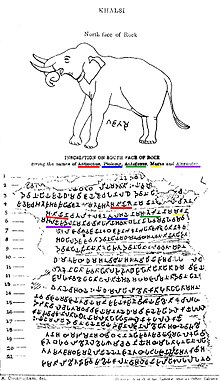


“And this (conquest) has been won repeatedly by Devanampriya both here and among all (his) borderers, even as far as at (the distance of) six hundred yojanas, where the Yona king named Antiyoka (is ruling), and beyond this Antiyoka, (where) four-4-kings (are ruling), (viz. the king) named Turamaya, (the king) named Antikini, (the king) named Maka, (and the king) named Alikasudara, (and) towards the south, (where) the Choḍas and Pāṇḍyas (are ruling), as far as Tāmraparṇī.”

This edict links a ruler called "Devanampriya with 4 greek rulers called  

  • Amtiyoko refers to Antiochus II Theos of Syria (261–246 BCE), who controlled the Seleucid Empire from Syria to Bactria in the east from 305 to 250 BCE
  •  Turamaye refers to Ptolemy II Philadelphos of Egypt (285–247 BCE), king of the dynasty founded by Ptolemy I, a former general of Alexander the Great, in Egypt.
  • Amtikini refers to Antigonus II Gonatas of Macedon (278–239 BCE).
  • Maka refers to Magas of Cyrene (300–258 BCE).
  • Alikasudaro refers to Alexander II of Epirus (272–258 BCE).
Well each of these Egyptian kings are identified using egyptian history (so no need to fudge date here).  Since their years also has been established,

We can say, the Indian king "Devanampriya" was living in say 230BC (probable date of this edict).  -> Point 1

2) Full text of 13th edict is as follows

"Beloved-of-the-Gods, King Piyadasi, conquered the Kalingas eight years after his coronation. One hundred and fifty thousand were deported, one hundred thousand were killed and many more died (from other causes). After the Kalingas had been conquered, Beloved-of-the-Gods came to feel a strong inclination towards the Dhamma, a love for the Dhamma and for instruction in Dhamma. Now Beloved-of-the-Gods feels deep remorse for having conquered the Kalingas.

Indeed, Beloved-of-the-Gods is deeply pained by the killing, dying and deportation that take place when an unconquered country is conquered. But Beloved-of-the-Gods is pained even more by this — that Brahmans, ascetics, and householders of different religions who live in those countries, and who are respectful to superiors, to mother and father, to elders, and who behave properly and have strong loyalty towards friends, acquaintances, companions, relatives, servants and employees — that they are injured, killed or separated from their loved ones. Even those who are not affected (by all this) suffer when they see friends, acquaintances, companions and relatives affected. These misfortunes befall all (as a result of war), and this pains Beloved-of-the-Gods.
There is no country, except among the Greeks, where these two groups, Brahmans and ascetics, are not found, and there is no country where people are not devoted to one or another religion. Therefore the killing, death or deportation of a hundredth, or even a thousandth part of those who died during the conquest of Kalinga now pains Beloved-of-the-Gods. Now Beloved-of-the-Gods thinks that even those who do wrong should be forgiven where forgiveness is possible.

Even the forest people, who live in Beloved-of-the-Gods' domain, are entreated and reasoned with to act properly. They are told that despite his remorse Beloved-of-the-Gods has the power to punish them if necessary, so that they should be ashamed of their wrong and not be killed. Truly, Beloved-of-the-Gods desires non-injury, restraint and impartiality to all beings, even where wrong has been done.

Now it is conquest by Dhamma that Beloved-of-the-Gods considers to be the best conquest. And it (conquest by Dhamma) has been won here, on the borders, even six hundred yojanas away, where the Greek king Antiochos rules, beyond there where the four kings named Ptolemy, Antigonos, Magas and Alexander rule, likewise in the south among the Cholas, the Pandyas, and as far as Tamraparni. Here in the king's domain among the Greeks, the Kambojas, the Nabhakas, the Nabhapamkits, the Bhojas, the Pitinikas, the Andhras and the Palidas, everywhere people are following Beloved-of-the-Gods' instructions in Dhamma. Even where Beloved-of-the-Gods' envoys have not been, these people too, having heard of the practice of Dhamma and the ordinances and instructions in Dhamma given by Beloved-of-the-Gods, are following it and will continue to do so. This conquest has been won everywhere, and it gives great joy — the joy which only conquest by Dhamma can give. But even this joy is of little consequence. Beloved-of-the-Gods considers the great fruit to be experienced in the next world to be more important.

I have had this Dhamma edict written so that my sons and great-grandsons may not consider making new conquests, or that if military conquests are made, that they be done with forbearance and light punishment, or better still, that they consider making conquest by Dhamma only, for that bears fruit in this world and the next. May all their intense devotion be given to this which has a result in this world and the next."

The edict talks about "Kalinga" war and Devanampriya turning to Budhism because of it. The tone and text clearly means an apology for war and provides guidence for future rulers not to wage war, but win hearts of people through "Dharma", "Intelectualism" and "good work". -> Point 2

3) Minor Edict at Maski, Raichur, Karnataka says,

A reconstruction of the edict reads thus: 
“For two and a half years I am a lay worshipper of Buddha. (For more than)...I have gone to...the Sangha...I have gone to...Before in Jambudvipa...now they have become mixed...This purpose is even able to be attained by a lowly person who is joined with dharma. It is not only to be seen that a high person might attain this. It is to be said to a lowly person and a high person...Doing thus...Thus (it will be) long standing and will increase (up to) one and half.” 
The edict is highly fragmented.
The Meaning is interpreted as

"Beloved-of-the-Gods speaks thus: It is now more than two and a half years since I became a lay-disciple, but until now I have not been very zealous. But now that I have visited the Sangha for more than a year, I have become very zealous. Now the people in India who have not associated with the gods do so. This is the result of zeal and it is not just the great who can do this. Even the humble, if they are zealous, can attain heaven. And this proclamation has been made with this aim. Let both humble and great be zealous, let even those on the borders know and let zeal last long. Then this zeal will increase, it will greatly increase, it will increase up to one-and-a-half times. This message has been proclaimed two hundred and fifty-six times by the king while on tour."


One can read the scientific paper from Indian author here....
http://www.ijhssi.org/papers/v4(3)/Version-3/F0433028031.pdf

Apart from associating the title ‘Devanampriya’ with Ashoka, the inscription suggests the spread of Mauryan rule up to the Krishna valley of northeastern Karnataka. Some historians believe that Ashoka must have attached some special significance to the region because he chose to reveal his name.


The edict links Devanampriya with "Ashoka" -> Point 3
The edict Links, Devanampriya Ashoka with Buddhism (worshipper of Buddha).
 -> Point 4

4) Megasthenes was the Greek ambassador sent by Seleucus Nicator in c. 302 B.C. to the court of the Indian king whom he and the Greek called "Sandrocottus". He was stationed in "Palimbothra", the capital city of the kingdom. It is not clear how many years Megasthenes stayed in India, but he did write an account of his stay, titled Indika. The manuscript Indika is lost, and there is no copy of it available. However, during the time it was available, many other Greek writers quoted passages from it in their own works. These quotations were meticulously collected by Dr. Schwanbeck in the nineteenth century, and this compilation is also available to us in English (J.M. McCrindle: Ancient India as Described by Megasthenes and Arrian). These accounts supplied some information about India of the time of the Macedonian king Alexander. It mentioned seven names of three successive Indian kings. Attributing one name each for the three kings the names are Xandrammes, Sandrocottus and Sandrocyptus. Xandrammes of the previous dynasty was murdered by Sandrokottas whose son was Sandrocyptus.

Problem with chandragupta as contemporary of Alexander is that, he succeeded his father (ghatothkatch and his grandfather srigupta was also a king).Linking samudragupta as Ashoka is also mischievous, as some indologists wants to fit the date of devanampriya with mahabharata war (which is derived to be in  3101BC). Mahabharata war reference was fixed due to Aihole epigraphy of pulakeshi-2.

All the scholars have relied on this inscription found in the Jain Temple at Aihole prepared by one Chalukya King Pulakeshi. It says, according to scholars, that the temple was constructed in 30+3000+700+5 = 3735 years, after the Bharat War and 50+6+500 = 556 years of Shaka era in Kali era. Today Shaka era is 1910. Hence 1910- 556 = 1354 years ago the temple was constructed. Thus the year of inscribing this note is 634 AD. At this time 3735 years had passed from the Bharat War. So the date of the War comes to 3101 BC. This is also the date of Kali Yuga Commencement.

Aihole script can be read here https://cbkwgl.wordpress.com/2015/01/19/chalukya-pulakesis-aihole-inscription/)

Since some Greek texts derived from Megasthanese talk about 154 kings and 6451 years from beginning of kingdom in India, historians could not fit the dates. There are 2 problems in interpreting Aihole inscription

A) The epigraphy says Bharata war (It is interpreted as Mahabharata war, but it could also means some great war important to birth of Chalukyas/Rajaputs)
B) The saka used is assumed to be shalivahana saka, popular in south. Using which the dating of epigraphic record is arrived to be in 634AD. It could be or it could be referring to some other saka also. Even if it is shalivahana saka, there are controversies to fix the saka beginning to 78AD.

But, scholars are trying to prove mahabharata happened in 310BC or 5561 BC
(https://hindunet.org/hindu_history/ancient/mahabharat/mahab_vartak.html)

5) We have three versions of a statement by Megasthenes, which can bear upon our problem.

Pliny (VI. xxl.4-5) reports about the Indians: "From the days of Father Bacchus to Alexander the Great, their kings are reckoned at 154, whose reigns extend over 6451 years and 3 months."

Solinus (52.5) says: "Father Bacchus was the first who invaded India, and was the first of all who triumphed over the vanquished Indians. From him to Alexander the Great 6451 years are reckoned with 3 months additional, the calculation being made by counting the kings, who reigned in the intermediate period, to the number of 153."

Arrian (Indica, I. ix.) observes: "From the time of Dionysus to Sandrocottus the Indians counted 153 kings and a period of 6042 years, but among these a republic was thrice established... and another to 300 years, and another to 120 years. The Indians also tell us that Dionysus was earlier than Heracles by fifteen generations, and that except him no one made a hostile invasion of India 

(study:- http://www.motherandsriaurobindo.in/_StaticContent/SriAurobindoAshram/-09%20E-Library/-03%20Disciples/Amal%20Kiran%20(K%20D%20Sethna)/-01%20English/Ancient%20India%20in%20a%20New%20Light/-003_The%20Momentous%20Evidence%20of%20Megasthenes.htm)


6) Regarding names Xandrammes, Sandrocottus and Sandrocyptus not matching phonetically with Nanda, Chandragupta  and Bimbisara. Consider the following facts

a) Darius III (c. 380 – July 330 BC), The persian emperor Alexander targeted was,  originally named Artashata and called Codomannus by the Greeks. Note how, greek names doesnot match Darius that one can find in persian records
b) Arthashastra is the famous book by chanakya. Does this name of darius has any influence from sanskrit?
c)Artaxerxes III was predecessor of Darious and Artaxerxes IV was the succcessor. After killing Darius, Bessus took the regal name Artaxerxes V and began calling himself the King of Asia.


The names of Nanda, chandragupta and Bindusara could have got changed due to codification (used in secret communications) while passing through persia. This is most probable, as Megasthenes  was an ambassador and was reporting to greeks. So, he would have used the names, as familiar to greeks. As we do not have original reference of Indica from Megasthanese, this can not be proved decisively.


Point 1 - 4 is there for everybody to see. Where is the question of vested interest here? Why Western historians tweaking come here? These are hard proofs.

Sunday, 3 December 2017

Indian National Anthem, Indian Emblem....


The Government has mandated that, we sing "National Anthem" in cinemas and now in hostels etc. The idea of inculcating "Nationalism" among Indians is a welcome move. But we have a major problem in "National Anthem" itself.
(Officially position of government is stated here https://www.india.gov.in/india-glance/national-symbols)


Image may contain: text

How many of you know, our national anthem is not written praising "our country", but praising "British Monarchy"? Yes it is 100% true from historical records. We the citizens of India and Armed forces of India are continuing to salute and pray for the well being of British Monarchy (like faithful slaves), instead of praying for our country and our people. If we sing this more often, what happens? Our thoughts and mind rest in slavery to the British Imperialism.
Rabindranath Tagore himself has accepted that, he was "coerced" to write this in praise of King George V, the emperor, who came to do "Delhi Darbar" (https://en.wikipedia.org/wiki/Delhi_Durbar) for the first time in India. The poet, Rabindranath accepts "in writing that", he has composed the song in "anguish". Why should we have such a song written under "duress" and in "anguish" as our "National Anthem"?
Read about the proof on this, published in TOI at
https://timesofindia.indiatimes.com/city/bengaluru/Was-Jana-Gana-Mana-in-praise-of-George-V/articleshow/32609087.cms

Janagana mana had 5 stanzas. You can check them at

https://www.ndtv.com/india-news/the-forgotten-stanzas-of-jana-gana-mana-464590


One of the stanza says
Your call is announced continuously, we heed your gracious call
The Hindus, Buddhists, Sikhs, Jains, Parsis, Muslims and Christians,
The east and the west come, to your throne
And weave the garland of love.
It means, we (all Indians) follow the "Orders" thrown at us, from the "British Throne". Isn't it insulting in "Independent India"? (So these stanzas are actually dropped).


(http://www.thehindu.com/opinion/open-page/tagore-and-that-song/article7342972.ece)

"However, the national leadership stood firm. By end-October 1937, the Congress Working Committee, which included Nehru, Bose, Vallabhbhai Patel and Abul Kalam Azad, declared that “…[the first two stanzas] described in tender language the beauty of motherland… absolutely nothing in them to which objection could be from the religious or any other point of view…” However, they stated that “[the other stanzas] contain certain allusions and a religious ideology which may not be in keeping with the ideology of other religious groups in India. The Committee recognizes the validity of the objection raised by Muslim friends to certain parts of the song… Taking all things into consideration therefore, the Committee recommend that wherever the BM is sung at national gatherings only the first two stanzas should be sung with perfect freedom to the organizers to sing any other song of an unobjectionable character…”

If this was decided and resolved before independence (in 1937) about "BM - Bande Mataram" as a national anthem, then why change it in 1950 without any specific reason? Note, Abdul Kalam Azad, a tall muslim leader of congress has represented Muslim community and accepted the resolution. Objection came only from Jinnah (as pretext to divide nation on religious lines). As Jinnah, moved out with Pakistan partition, there was no more objcection in 1950. Final decission even in 1950 was, Bande mataram should enjoy equal status as that of janaganamana". Why all these confusion?

The intellectuals write anything and twist and turn history using words. But look at it yourself. The song is about nation (theme is nation). Tagore himself says, religion should not be brought for a national song (while commenting for BM, so he was aware of the kind of rules). Then, why he brings "God" in his own song ( Adhinayaka and Bhagyavidhata ). How can this contrast exist? When nation is being praised as supreme, why bring god here? The sequence with which the song was written was acknowledged by Tagore that, he was "requested" to write a song for visiting  royals (this is not disputed by any). No where, Tagore says, he refused to do so (which means, he did write fulfilling the request). When a high ranking official "request" (that is actually an order) for an important event, can Tagore write a song for god instead of royals and escape (he would have been charged with sedition, if he had done any of them)? India always respected visitors (athiti devo bhava). So, writing a song welcoming the royals as visitors was not objectionable to the poet (or to anyone). Also, if it was just a welcome song, it would not have caused "stir for the poet". The issue was, he was ordered to write a felicitation song (meaning, praising British king by equating him as god). Only this kind of sermons could create "stir within the poet". So, all intellectual explanation (saying Adhinayaka/Bagyavidhata refer to god) is just farce and came in defense from congress camp.


http://epaperbeta.timesofindia.com/Article.aspx?eid=31812&articlexml=No-takers-for-Hindi-version-of-Jana-Gana-23092015002048#

Look at how Indians are fooled. It says, colonial authorities "propagated" that Tagore composed the song for King George 5. Why would Britishers do propaganda like that, under their own rule? Instead they could have easily coerced tagore to write and accept it like that. This proves, british sources also confirm song was written for King George V. This statement/argument of propaganda is just coming, post independence (from congress). Infact Britishers wanted to announce, Full Indian subjugation and quell all secessionist movement (that was the. O intention of song. So, all parts of India, assets of India like rivers of India are mentioned in the song and they collectively offer their subjugation before "Vidhata". One thing is clear, Either it was a fact or the accusation came from colonial powers and not from Hindu or Indian nationalists (as congress would blame today). If this controversy was there before independence, then why choose it? Why not write a fresh song and adopt with no controversies?


The "official report" of the 26th Session of the Congress, accepts, song of welcome to Their Imperial Majesties composed for the occasion was sung by the choir. Note the record refers "Janaganamana" as "patriotic song". Patriotic song under British rule can only be praising the "British Empire" and not a secessionist Indian state. In 1911, congress was probably looking for autonomy and not independence (as British rule was strongest, with every Indian king submitting himself at the British coronation in Delhi Darbar). The situation changed quickly due to WW1 and WW2. The ambition of "autonomy" became "Independence". If you read about Tilak, it is clear what was happening at that time in congress. [Tilak joined the Indian National Congress in 1890. He opposed its moderate attitude, especially towards the fight for self-government. He was one of the most-eminent radicals at the time. In fact, it was the Swadeshi movement of 1905-1907 that resulted in the split within the Indian National Congress into the Moderates and the Extremists]. During his lifetime among other political cases, Bal Gangadhar Tilak had been tried for Sedition Charges in three times by British India Government—in 1897,1909 and 1916. Note sedition for Tilak for demanding "Swarajya" in 1916. Tagore would have faced the same charge in 1911, if the song was composed for Independent India. The "Bhagyavidhata", a "male gender word" reveals that, it is the king and not India  that was praised. India is a "Motherland" and we can't refer it using male gender words. But, We still sing as "Bhagyavidhata". So our national anthem is not about our country at all.

[Tilak re-united with his fellow nationalists and re-joined the Indian National Congress in 1916. He also helped find the All India Home Rule League in 1916–18, with G. S. Khaparde and Annie Besant. After years of trying to reunite the moderate and radical factions, he gave up and focused on the Home Rule League, which sought self-rule]. This proves congress was not fighting for independence as of 1916 also. So, why would they compose and sing a "patriotic song for Independent India in 1911"? What more proof is required than this?


George V's coronation was unique, as he was the first (and only) English royal to get coronation in person in India (with whole of India bowing before him) like that of "Shahajahan". Mughal court was the "bench mark" for westerners, as the mughal richness was the main attraction that brought Europeans to the Indian shores (You can still see the rich model of Aurangazeb's court made using precious Gems that was shown across Europe at that time in "Dresden palace". You will be stunned to see the rich model).


https://www.saxony.in/UserFiles/Image/india_meets_saxony/3_1/3_1_1.jpg


Issue is simple. why did constituent assembly adopted this song in hurry? Was it difficult to get a song written for the new nation? Why select the one, that was already known to have been written to welcome and praise British royalty?


India was duped while selecting emblem also.


No automatic alt text available.

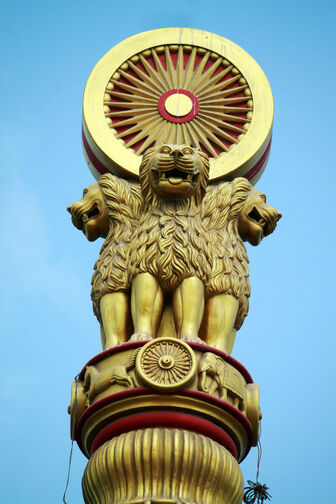
The emblem looks great for artistic angle. But was it right to choose it as the emblem for India? The four lions of Ashoka, is a symbol of Imperialism. It represents "Brutal Ashoka" before his charity started (Ashoka was referred like that in contemporary History. The Great Ashoka is coined later by Britishers). The Four lions indicate "Imperialism" in all directions. We fought against "Imperialism" for freedom. What does the imperialistic symbol communicate, an aim to become one? Idea of India is definitely not imperialism. Idea of India is for "Peace, Humanity & Tranquility". The country believed in "Sarve jano sukhino Bhavanthu", peace and tranquility for all. The emblem should communicate this idea of the country. In what way, does 4 lions represent India?

Natural choice for India for emblem should depict "Dharma Chakra, the wheel" as the main item. The wheel symbolizes "peace & justice". Probably, the full emblem of ashoka (four lions with Dharma Chakra)should have been the emblem.

Image result for dharma chakra the wheel


(Ashokan Wheel)


Image result for dharma chakra the wheel

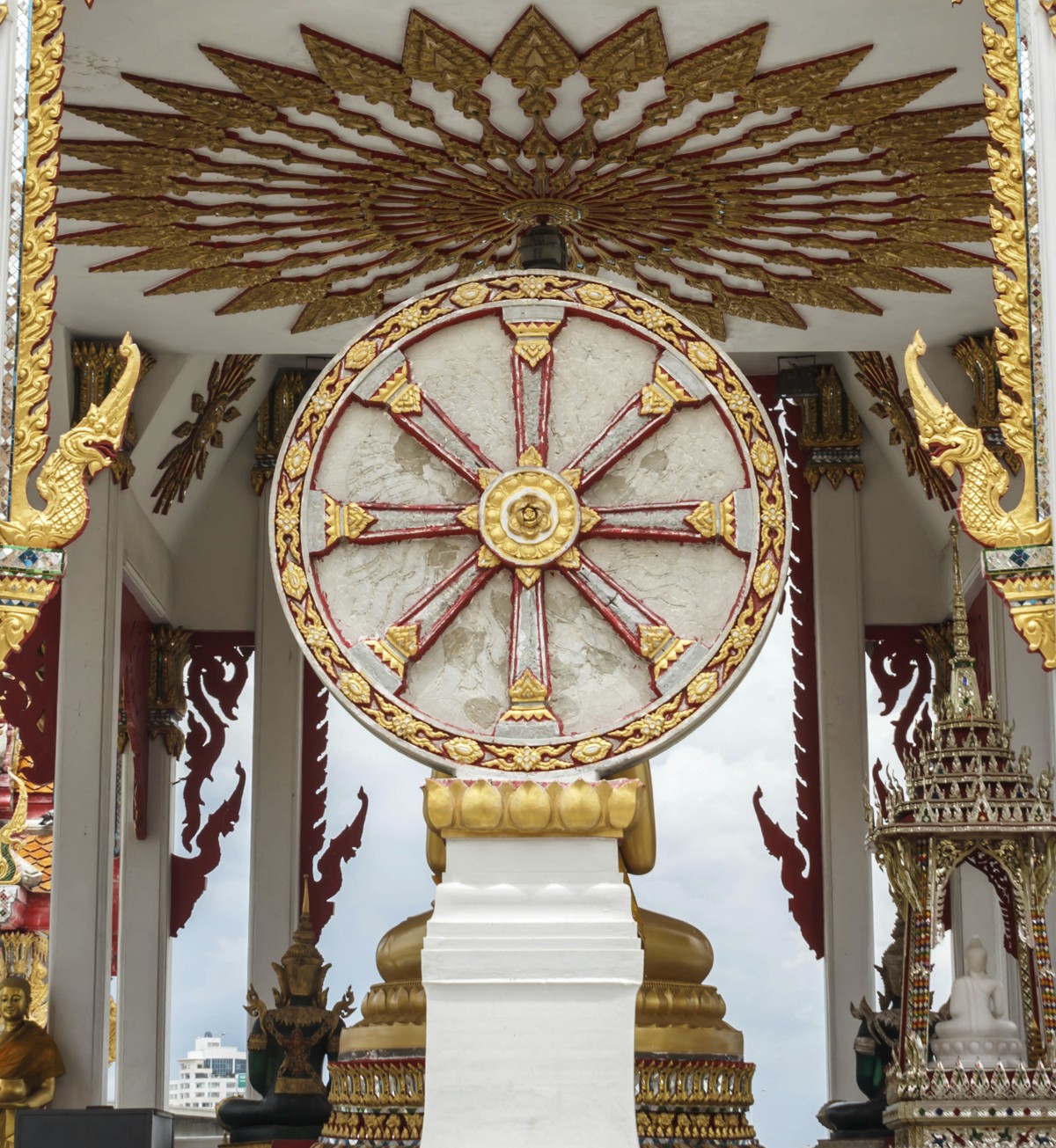
Hindu Wheel or kalachakra. Wheel also has an apparent meaning with sun & moon. It normally indicates "Dharma/rule of law" during cycle of day and night and the cycle of birth and death.


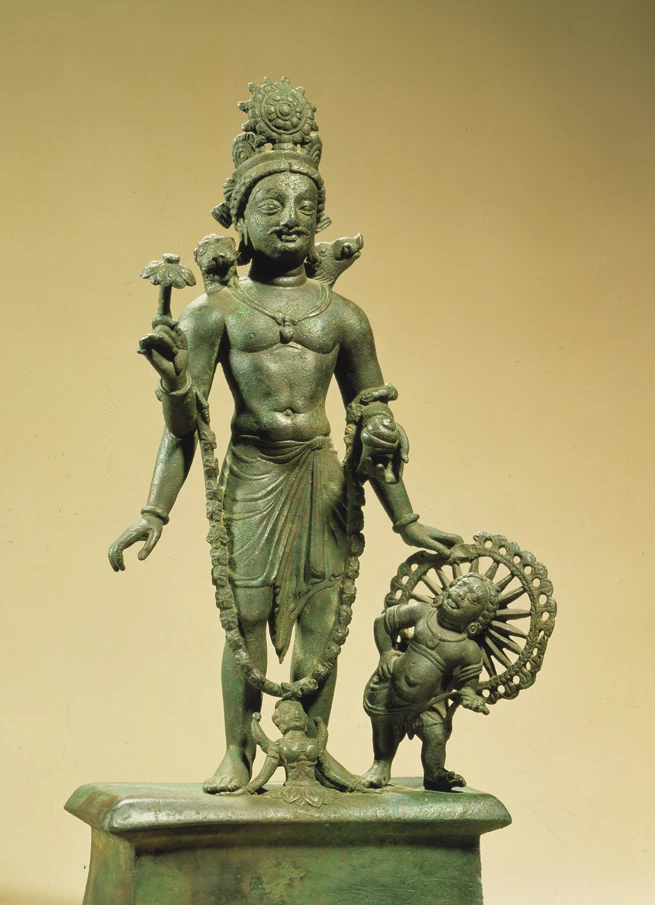
Vishnu, imparting Dharma to humans by coronating a king with his chakra (A statue from present day pakistan). Also observe the wheel in the crown of vishnu.


Image result for indian crowns

The circle behind the crown worn by gods and kings indicate "rule of law" or "protector of Dharma" for one and all.

Image result for dharma chakra the wheel

Related image

A Budhist Wheel, Dharmachakra or Wheel of life

Image result for dharma chakra the wheel

(Wheels of many religions)

This was not selected, as Britishers wanted to keep their shadow foot print, even after leaving India. East India company had 3 lions.  Note, The emblem of British monarchy is a lion (in their coat of arms). "4 lions" for India means, shadow power with 4 times effect.

Related image


Image result for Union jack and lion
   
(UK, symbolized with a lion and union jack).


Image result for britain lion
(British Royal Lion in their logo).
Image result for british royal emblem england

(Royal coat of arms of England. See how 3 lions are subjugated under the big daddy).

Image result for british royal emblem england

(Royal Badge for Wales. 4 lions subjugated under the crown).


Related image

This is what Britishers meant. 4 Indian lions following big daddy!


(British Indian Flag with star of India. Even "British India" chose a wheel for India in its logo).

Image result for british india emblem

You know, what we use for Indian cricket. The same "British Indian Logo, star of India".
Related image

And see the emblem of English cricket team (3 lions).
Related image


In-fact, above the 4 lions, even Ashoka incorporated the "Dharma Chakra", Indicating Peace & Justice for all under his imperial banner. The 4 lions, still Indicate "Imperialism" even with the Dharma Chakra. Skillfully the chariot wheel is interpreted as dharma chakra in indian logo. But, the 4 lions on top of dharma chakra could mean, rulers are exempted from judicial scrutiny and above law (like the one in dictatorships). We do not want such a system in India.


Related image

The real emblem had a big wheel on top of 4 lions, indicating supremacy of law (Dharma), irrespective of creed. This is not, what we adopted. Why did the rulers missed the top most wheel?

Related image

Infact, supreme court  of India, has adopted the right logo, as they understand "supremacy of Law".

British logo indicates, British crown is supreme. It controls imperialism (lions). Ashokan emblem in full indicates, "Dharma or Rule of Law" is supreme. "Dharma controls Imperialism or power". In India we, chose just 4 lions with nothing above it for government, Indicating Imperialism (or power) is supreme, as far as government is concerned.  

Lion as an animal, that is not common in all parts of India. Tiger or Elephant used to be royal symbols in India, as they were common through out . Many Indians used, mythological animal called sharabha (combination of elephant and lion). Tiger or Lion can not be used in a war, but elephants are a formidable force. So, for Many royal houses, Elephant was the royal symbol. As Indian Ivory was a precious commodity, Elephant is equated with India. If Government of India wanted to use an animal in its emblem, Elephant was a natural choice. Elephant represents strength and not imperialism. But intentionally 4 lions were selected.

Image result for travancore emblem

After WW2 nuclear event, world looked for "peace symbol". They also came to a wheel finally (https://en.wikipedia.org/wiki/Peace_symbols)


Finally, Some one sensible, insisted the use of "Chakra" (also from Ashoka) and changed gandhi wheel to ashokan wheel as part of national flag.

 Image result for ashokan wheel

Today all Government orders goes under the symbol of 4 lions (which symbolizes "stamp of shadow" power). We see the 4 lions every now and then. But we rarely think about it. We are just ignorants.


In fact, the issue doesn't end just at "National Anthem/Emblem". There is more history hidden behind it.

King George V, in whose memory Janagana mana was composed is the crucial person, under whom, the "controlling power" of India shifted out of the British government. He had 2 cousins, one was emperor of Germany and another was emperor of Russia.

Image may contain: 3 people, text


Britain was at its top most power position, as a family was controlling 3 of the powerful nations at that time. Britain crown kept the tight grip and influence on whole world.

However due to "Leftist ideology", Both Russian emperor and German emperor were toppled. Germany came under influence of Hitler and Russia under Stalin. Hitler was brutal regarding monarchs. He eliminated all people under the old regime and cleaned up the administration, so imperialism dose not influence his plans and execution . Russia however was bureaucratic. Only royals were eliminated. Influential people in the administration chain, just switched their loyalty from emperor to Marxist party (Like Indian business men) and retained their positions. Germany wanted to capture Russia or Britain, so that they will be the true "super power". British Royals, out of fear made secret pact with Russia to save themselves. It was two way agreement. Britain to help Russia, if Germany attacks Russia or the other way round. Attacking Russia was risky for Hitler, as supply lines were far from the German factories. Hitler made plans to attack Russia during one of the winters (when snow gives cover and gives an element of surprise). After fall of France, Britain become easy target, as it was easy to attack Britain from French coast. Britain suffered heavily due to German bombing. It cried for help from both USA and Russia. USA was reluctant, as they kicked out Britain from their civil war earlier and were still in disagreement with Britain over transatlantic trading pacts. More over, they did not want to get themselves entangled in an European power struggle. France was of major concern to USA than Britain/Germany (that is why we see statue of Liberty in NY), as French had established considerable influence in Europe, Africa and Asia. Out of options, British royals were ready for any pact with Russians, in exchange for protection now. Stalin saw an opportunity. British offer was too tempting. Russia was drawn in to war, as they started supplying war material to Britain secretly. This was breach of contract between Russia and Germany (as Russia was bound to supply only to Germany and not to its adversaries during war). This breach of contract, angered Hitler. He thought, if supply lines support Britain, from Russia, he will not be able to take Britain for long time. So, He decided to punish Russia. So, while still at war with Britain, Hitler decided to attack Russia (This was too much as he took on two powers together). When, Hitler attacked Russia in winter, Russians were also ready (as they were also preparing to invade Germany in support of Britain. Element of surprise, that was key to win this battle was lost). Russia was rich with resources and Hitler could not provide the needed resources during winter for the elongated war. USA joined the war due to Japan and it strengthened allies. Hitler lost the war, when Russians entered the capital Munich. Of the 3 powerful cousin emperors, only British throne survived the war. This was summary of WW2.

After war, Britain lost its power completely. It was in ruins. Royals became puppets in the hands of Russians. Although Britain joined NATO, Royals were suspected to be under the protection of Russians. This was the only way, they could hold on to their royalty. To avoid power struggle, royals were sidelined and told to manage India and not interfere in British state affairs. This way, British Royals became agents of India and India indirectly came under Soviet control. By this time, In India, masses were fed up of puppet royalty and foreign rule. A weak Britain means an opportunity to revolt and end result was fragmentation of India again (many kingdoms were contemplating to declare independence from British India). The British royals were under threat of loosing India too and loose their relevance. They had no way but exit India, to keep India united under democracy. They planned to do it by installing a central puppet government. The only business of royals, since then was suspected to route Indian wealth to "Left center of power". So, when we sing our national anthem, we indirectly begging the foreign power for our destiny, who is still tormenting us. This should explain, why Nehru opted out of offered UN seat, disappearance of Subhas chandra bose, sidelined all freedom fighters etc. Probably, Shastri tried to free India from the clutches of foreign power. His efforts were countered by thrusting an Indo-Pak war and eventually eliminating him in secrecy.

The fight between these two super powers (right vs left) are still being played. Ready grounds are Korea, middle east, Eastern Europe, Afghanistan, India, South China sea and Germany. These are the conflict points. Recently we see reverses at some places for "right center of power located in west" (like North Korea, Middle east, jasmine revolution toppling dictators etc). To compensate, they are forcing changes in Afghanistan, India etc. India still not fully free to implement a " successful Made In India/Make In India program and cut its import bill (that is how wealth is taken out of India). Indian justice system & media are too complicated and keeps the public busy, while laws are tweaked to favor right or left foreign power (in the name of investments). Indians continue to suffer, while the benefits are en-cashed by outsiders in the name of stability/democracy/peace/threat of conflict/ threat of fragmentation of India etc (by escalating right vs left conflict in India). May be the cost we are paying for the peace is too much loaded.

The point is simple. Now a "Nationalist" government is in Power. They claim, National interest is above everything else. If they do "walk the talk", the first thing they would have done is
a) Replace the slave song with our own national song (an acceptable one to all Indians and written exclusively for this purpose) that is appropriate. The party in power has talked about it at various occasions in the past, but while in power they are silent on the issue. We have so many contenders for national anthem and there are many talented writers to write an improved one, if required. No pucity of talent in India.
b) Stop showing military honors at WW1 memorial (India Gate), which was basically constructed for British soldiers and insult our forces. Instead, construct a grand military memorial in respect of our fallen Indian soldiers and people in various battles, including against British (this is the reason, why it is blocked till now, as it offends the British and they do not want this).
These two should have been a more priority items than constructing temple for Rama or Statue of Shivaji or Statue of Patel. They may be important, but priority for nationalist party should have been to fulfill nationalist interest first. The government can't take decision in this regard, probably indicates, India is probably not "as independent and free" as we think. What do you think?

Friday, 10 November 2017

Real story of how Hoysala Kingdom grounded and Vijayanagar rose

We should know, how Hoysala kingdom came to its end. The "Beginning of Hoysalas" in the form of "sala story" is widely circulated, but end of Hoysals is not so discussed and understood by people of Karnataka. It is an horrible account and Indian historians have skillfully masked it from public account. The event was so horrible that, it gave rise to a new kingdom Vijaynagar, immediately in revenge. 
Read the "real story" documented from Portuguese account written in a book "A Forgotten Empire: - Vijaynagar". It is made accessible to public from a library in UTTAH., USA. (http://www.gutenberg.org/cache/epub/3310/pg3310-images.html)

In 1334, Sultan Muhammad (Muhammad Taghlaq) marched southwards against his rebel nephew, Baha-ud-din Gushtasp, who had fled to the protection of the "Rai of Kambila," or "Kampila" as Firishtah calls the place, in his stronghold amongst the mountains. The title "Rai" unmistakably points to the Kanarese country, where the form "Raya" is used for "Rajah;" while in "Kambila" or "Kampila" we recognise the old town of Kampli, a fortified place about eight miles east of Anegundi, which was the citadel of the predecessors of the kings of Vijayanagar. Ibn Batuta goes on to say that the Raya sent his guest (Baha-ud-din) safely away to a neighboring chief, probably the Hoysala Ballala, king of Dvarasamudra in Maisur, then residing at Tanur. He (Raya) caused a huge fire to be lit on which his wives and the wives of his nobles, ministers, and principal men immolated themselves, and this done he sallied forth with his followers to meet the invaders, and was slain. The town was taken, "and eleven sons of the Rai were made prisoners and carried to the Sultan, who made them all Mussalmans."

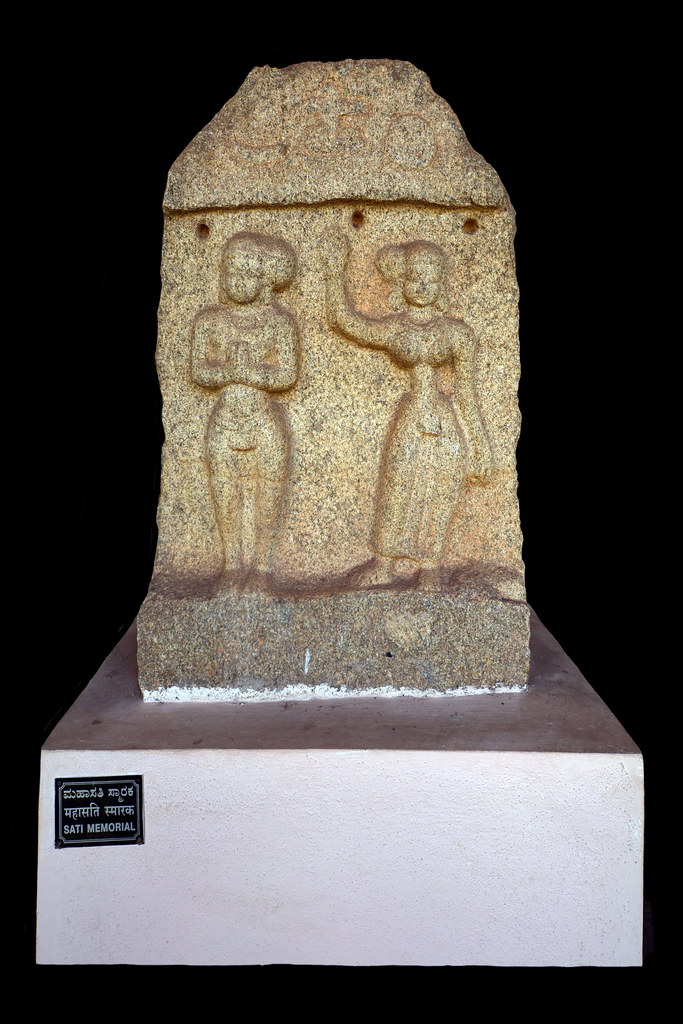
[Note the predecessor of Vijaynagar (Called Rai/Raya), a chieftain of Hoysala Empire had to burn their women before going to war. We hear only about rani padmavathi, but we are ignorant of our own, kannadiga women who met the same fate].

https://c1.staticflickr.com/8/7504/15381718384_0c6a9f377d_b.jpg
[Sati stone at Elephant stable in Vijayanagar. There must be a proper research conducted by ASI/historians in to these stones around hampi to re-establish the sati event, that marked the end of Hoysalas with historicaly verifiable facts like date etc...These stones are the 'Proof' for this historical event]

After the capture of the fortress the Sultan, according to Ibn Batuta, pursued Baha-ud-din southwards and arrived near the city of the prince (Hoysala Ballala) with whom he had taken refuge. The chief abandoned his guest to the tender mercies of the tyrant, by whom he was condemned to a death of fiendish barbarity.

[Balalla lost and ran away. Thus ending the glorious chapter of "Hoysala Kingdom"].

"The Sultan ordered the prisoner to be taken to the women his relations, and these insulted him and spat upon him. Then he ordered him to be skinned alive, and as his skin was torn off his flesh was cooked with rice. Some was sent to his children and his wife, and the remainder was put into a great dish and given to the elephants to eat, but they would not touch it. The Sultan ordered his skin to be stuffed with straw, to be placed along with the remains of Bahadur Bura,[26] and to be exhibited through the country."

[This is the punishment meted to the kings own nephew. Karnataka experienced ISIS brutalities]

After the capture of Anegundi in 1334 the Sultan left Malik Naib as his local governor, and retired northwards. The country rose against the usurpers, and after a time the Sultan restored the principality to the Hindus, but made a new departure by raising to be Raya the former chief minister Deva Raya, called "Deorao". He reigned seven years. During his reign this chief was one day hunting amongst the mountains south of the river when a hare, instead of fleeing from his dogs, flew at them and bit them. The king, astonished at this marvel, was returning homewards lost in meditation, when he met on the river-bank the sage Madhavacharya, surnamed VIDYARANYA or "Forest of Learning," who advised the chief to found a city on the spot. "And so the king did, and on that very day began work on his houses, and he enclosed the city round about; and that done, he left Nagumdym, and soon filled the new city with people. And he gave it the name VYDIAJUNA, for so the hermit called himself who had bidden him construct it."

Thus, in or about the year A.D. 1336, sprung into existence the great city which afterwards became so magnificent and of such wide-spread fame.

A variant of this relates that the two brothers for some reason fled direct from Warangal to Anegundi. This account redounds more to their honour as Hindus. Though compelled first to accept service under their conquerors, their patriotism triumphed in the end, and they abandoned the flesh pots of Egypt to throw in their luck with their co-religionists.

Another states that the two brothers were officers in the service of the Muhammadan governor of Warangal subsequent to its first capture in 1309. They were despatched against the Hoysala Ballala sovereign in the expedition under the command of Malik Kafur in 1310, which resulted in the capture of the Hindu capital, Dvarasamudra; but the portion of the force to which the brothers belonged suffered a defeat, and they fled to the mountainous tract near Anegundi. Here they met the holy Madhava, who was living the life of a recluse, and by his aid they established the kingdom and capital city.

A fourth story avers that the hermit Madhava himself founded the city after the discovery of a hidden treasure, ruled over it himself, and left it after his death to a Kuruba family who established the first regular dynasty.

[ There are various stories regarding the origin of Hakka & Bukka. Most probably they were the 2 out of the 11 captured princess and converted to Islam. After conversion they were forced to reside in warangal. They escaped to return back to Hinduism. Sage Vidyaranya helped them to "re-convert" and gave the required sanity. To hide this un-pleasent account of converting to muslim religion, stories were flouted regarding the family of origin of Hakka and Bukka. In most probabaility, they were decedents of "Rai/Raya" who was feudatories of the Hoysala Ballalas. Without this connection, it was difficult to assemble soldiers of the lost kingdom of Hoysalas. As they were seeking revenge against northern sultans, revolted public supported them. The required "Trust" was catalised by sage vidyaranya.]

[Indian account on the birth of Vijayanagaram is described beautifully here. https://freeindia.org/biographies/sages/vidyaranya/index.htm

Mudiraja Community, which claim inheritance from "Kapila Raya" have documented the references available in many documents here 
http://mudiraja.weebly.com/15-kampila-raya.html 

Kumararama story that lives on in folklore and literary works is another source of information for the event.
http://www.shastriyakannada.org/DataBase/KannwordHTMLS/CLASSICAL%20KANNADA%20LAND%20HISTORY%20AND%20PEOPLE%20HTML/KUMARARAMA.htm
]

Thursday, 9 November 2017

Objective in Life - "Happiness" Vs "Sucess"

There is a key difference between West and East. The difference is in "Defining" What is the "objective" of life. Eastern philosophies like "Indian philosophy" advocates, "Happiness" in life as the objective. Western philosophies advocate "Success". But why is this important? This objective is important, as it defines ones life and it is all the more important to understand why it does so.

Many people are confused on this subject and they keep looking for "this objective in life" every now and then. "Objective" defines the "Target". "Target" defines the "Direction". "Direction" sets the way you "sail through in life". That sail or "Path" defines everything else in your life. Since people do not understand the larger picture, they will be clue less now and then. They start looking out to get some short term "goals", like education degree, job, marriage, retirement benefit, house, car etc...etc. When they get these targets  in life, they start working for these "targets like slaves". Once the target is reached, they are clue less again and start the exercise from beginning for the "next target". 
 
If you ask anyone, "Are you Happy"? the common answer will be, "ya I am" with a strange look on their faces (some of them never understood what is happiness and obviously they never understood the question). If you dig more, they will say, they are "getting" what "they want" and hence, 'obviously', they are "Happy". This is because of the "poor education" and the "conditioning of our mind" by "vested business interests". Getting what you want does not make you happy. In-fact it does the exact reverse. It actually makes you move up the ladder and seek the next "thing" in life. You seek the next bigger model of car/phone or next bigger house, because, you are not satisfied with what you got in the first place. Just think, If you are "not going to be satisfied" with what you are getting after a short period of time, then why waste effort, money & time (that are so scarce) on them instead of something that is going to give satisfaction for a long long time? Unfortunately, One will get this question at retirement age and they will be asked to seek religious discourse as a solution. If this question pop in the schooling time, then their entire life will be more efficient and economical, as they will be spending their scarce resource on the right objective in life.
 
Keeping customer in an eternal "unsatisfied condition" is central to "demand generation" in capitalistic philosophy. So, all advertisements aim to mock your "current condition" (so you start seeking ways to upgrade) or define "what you should be geting next" to be successful in life. Note, once you move up, there are many things lined up to define, what you should be getting next. This list of "next" things, keeps you in 'eternal unsatisfied condition', while your mind naturally wants to go to 'eternal satisfied condition'. The difference in these 2 states causes all problems in life. The problem is, we have allowed external actors to define the 'objective' in our life. We should stop this phenomenon by proper 'education'. We should be mature enough to define, our own objective and be able to set direction in our life. Once we do this, we are in control and we will be moving in the right direction.

The western world try to impose a view that, meeting these small goals is "stepping stone" in life and "to be successful" is the objective in life. But question is why do you want to be successful? Many animals do not work for small objectives to move in evolution chain? Then why do they exist? That is where the supremacy of eastern philosophy comes in to play. From vedic times, it is made clear that, objective in life is simply "to be happy". In-fact, to be "more and more Happy". In-fact that "More and more happy is also not sufficient", and hence one should target to become "Happy for ever". "Happy for ever" is  the "Moksha" / "Chidananda".

To be "successful" is one way to become "Happy". Note, not all successful people are happy. Then, when will success brings happiness? Success brings happiness, when you are able to "accumulate" something with you. This "accumulation" that is excess or abundance, brings "Happiness" for you. The "Success" that the western philosophies advocate is to "accumulate" wealth or in very narrow meaning "money". The abundance of "money" makes you happy. Many a times, people are seen successful, but they have not accumulated any thing (in fact the cost of success may be more than the benefits). So, not all success "brings happiness".  
 
So, when you dig western philosophies, you will find out that, to get this "Happiness" you should be "successful". This inherent explanation already proves that, "success" is not the end goal, but "Happiness" is the end goal. Thus proving the supremacy of the eastern philosophies. But why should "Abundance" gives you happiness? Abundance gives happiness because, you can "give that excess". So in reality, it is not the act of accumulation or the state of abundance, but the "act of giving", gives you happiness. Off-course, to give, you should have that abundance in the first place. Without this abundance, you have "fear". The "Fear to be poor" and not able to match the demand in our life. So, you accumulate. 

Now, you must have understood, "Happiness" is the 'real' goal. But how do we measure happiness? How do we know, we are happy in first place? It is an already established fact that,  if we can't measure, we will not be able to achieve it. The answer is simple. When you are happy, you start giving. You can only distribute joy and not sadness. The people in sadness, look for someone to share their burden. So, if you see people seeking for resources (or garbing resources), you will recognise the "sad people".  When you see people giving out, you know they are "Happy". So the question, how to identify 'happiness' is answered. Now the question on "How much". The answer of "How much" of happiness can be directly liked to, "How much one can give". One can give more, if at all, he has more. The measure of richness is not "How much you have", but "How much you can give". So, the formula is to "Have more" and to "Give more". Similarly, how much one seeks/try to grab will define "How much Sad" he is. We see lot of "sad people" all around us today. 
 
But why does the "Abundance" gives happiness? Abundance gives happiness, as it indicates, it has "Satisfied your need". The sense of satisfaction gives you a feeling of "Bliss", "security" and "confidence". This state of mind, having a sense of "security", "confidence" and "bliss" is nothing but "Happiness". Note, "Act of giving" means, giving without expecting and/or taking anything in return. If you expect or take any material benefit in return, it becomes trading and constitute a business. If you do not expect and/or take anything, then you get 'Happiness" in its place. So, Happiness is the "Return benefit" for you.

The 'Core point' to understand here is, 
  • "Giving" gives Happiness.  
  • "giving more" gives "more happiness". 
Note the important point. Giving "what you have" is important. Also note, giving doesn't mean giving to charity alone. Giving to anyone selflessly (means not rewarding yourself) qualify as giving. Giving to your family, serving your parents also constitute as 'giving'. Off-course, giving to society/charity amplifies your giving, as it serves larger interest. Note the important thing, serving larger interest, in the end is important. Just giving to some thief or considering "your loss" as donation will not qualify as "giving". That is why it is stated that, "You should always donate willingly and you should donate to the needy".   

"What you have" is not limited to "Money" alone. One can give lot of things apart from 'money'. For ex, one can give, 'love', 'affection', 'sense of security', 'food', 'time', "manual labor", 'loyalty', 'Talent', 'skill', 'knowledge' etc..So one need not work alone to accumulate money. One can also work to accumulate all these valuables. This is the reason, many 'artists' will be happy, although they may be "poor in monetary terms". Always work to accumulate one of these items. If you have "more" than, what you need, in any of these resources, it makes you a "rich person". Working to accumulate one of these in a targeted way, makes you rich in that "item" (and in an efficient way). 

Once you are clear about this, lot of confusions in life will go away. You will have meaning in your life and work. As your objective is clear, changes in life, like loss of job or loss in business or loss of an individual or a dear one doesn't affect you much. Work to accumulate something, during your workable age, so that you can give your abundance when the need arises. 

You check on any school or syllabus of education. They claim, the main object of education is 
  • to prepare a student physically and mentally to the future challenges in life 
  • or to define ones personality 
  • or to prepare a valuable citizen or human being etc..
In reality, children are "happy" by birth. Life forces, will "interrupt this happiness" naturally. Objective of education is to prepare a child to realize, the ultimate objective in life is nothing but, "to be happy as much as possible and to be happy as long as possible". The education should impart, what is happiness, how to get it, how to sustain it and how to cherish it. Then there will be meaning to education. You must have heard the term "Learning through Play". The concept comes because, maximum learning happens, when the mind is in "happy state". "Happiness" is the central theme of education. In todays scenario, when education has become money making business, Educators, policy makers, teachers, parents and students all are in dark. As objective of education has moved away from "happiness" to "money making", vested interests have kept everyone in dark and are simply confusing everyone with "various concepts", so that people, who are customers, do not question the outcome but simply pay for it. 
 
Parents, please wake up. Do not stress your child. If S/he is not happy, it means, S/he is not going to learn anything. S/he will be confused and direction less through out his life. Work with your child to find out, what makes the child happy. Try to pursue options in that direction. Impart the awareness that. "To be happy" in the end is more important. They know naturally, what to do. Let the child accumulate, using his/her strength, that he can willingly give. 'Money' is not the only thing to accumulate in life.